A Reading Recommendation
“In the June issue, sculptor and philosopher Januš Suša invites you to read.” A personal column on slow reading and four books held between the archaic and the contemporary — Gene Wolfe, Milton, Dante and Werner Herzog.
From childhood I especially remember the telling and reading of the Grimms’ and Andersen’s fairy tales, and the feelings evoked by selected Slovenian, Russian and Chinese tales. Perhaps this is where my interest in narrative comes from — narrative that, in its most accomplished forms, can be distinguished by a fusion of artistic expression and philosophical thought. As a child I also read a great deal of palaeontology — books about prehistoric animal life and geological eras. In secondary school I was especially drawn to our treatment of Dante’s Divine Comedy and to my matura novel, Maja Haderlap’s Angel of Oblivion. Towards the end of secondary school and the beginning of my studies I devoted much of my time to specialist literature and relatively little to private reading.
As an artist and student I currently spend most of my time reading specialist literature — books and articles on art and philosophy — but over the last two years I have returned to reading for pleasure.
My reading practice favours slow, analytical reading, which has probably also shaped my personal taste for denser prose and the occasional reading of poetry. I am quite fond of thought at the intersection of the archaic and the contemporary, especially when together they give rise to ontological reflections on existence and action — where I find myself within the philosophical current of phenomenology and relationality. In my reading taste I currently move somewhere between the old, the classical and the new.
Gene Wolfe, The Book of the New Sun. Half a year ago a fellow sculptor won me over with Gene Wolfe’s The Book of the New Sun. The author presents the work as science fiction written in the fantastical language of prose, and his writing reflects the enigmatic nature of the work — in content and form alike — which is what drew me to it. Because of its dense prose and multi-layered character I have put most of the book off until summer, but I recommend it to anyone drawn to an antique aesthetic of language and a hidden fantastical content.
John Milton, Paradise Lost. For some time now I have been called to the classic of the English late Renaissance, John Milton’s Paradise Lost, which — in its epic character, its mythic-religious and spiritual content and its extraordinary lyrical prose (even though it is an unrhymed epic poem) — currently draws me, I am not quite sure why, both to reading and to listening. This is all the more striking because Milton wrote the crown of his oeuvre in the autumn of his life, having lost the fruits of his political aims with the restoration of the monarchy in England (which put his own life in danger), and at a time when he had already gone completely blind. He composed the poem gradually and dictated it aloud to his daughter — which, personally, lends more intoxicating weight to Milton’s spoken word than to merely reading the written text. He himself conceived the work, or at least originally defined it, as something “unattempted yet in prose or rhyme”, intending with it to stand alongside the great epics of Homer, Hesiod, Virgil and Dante.
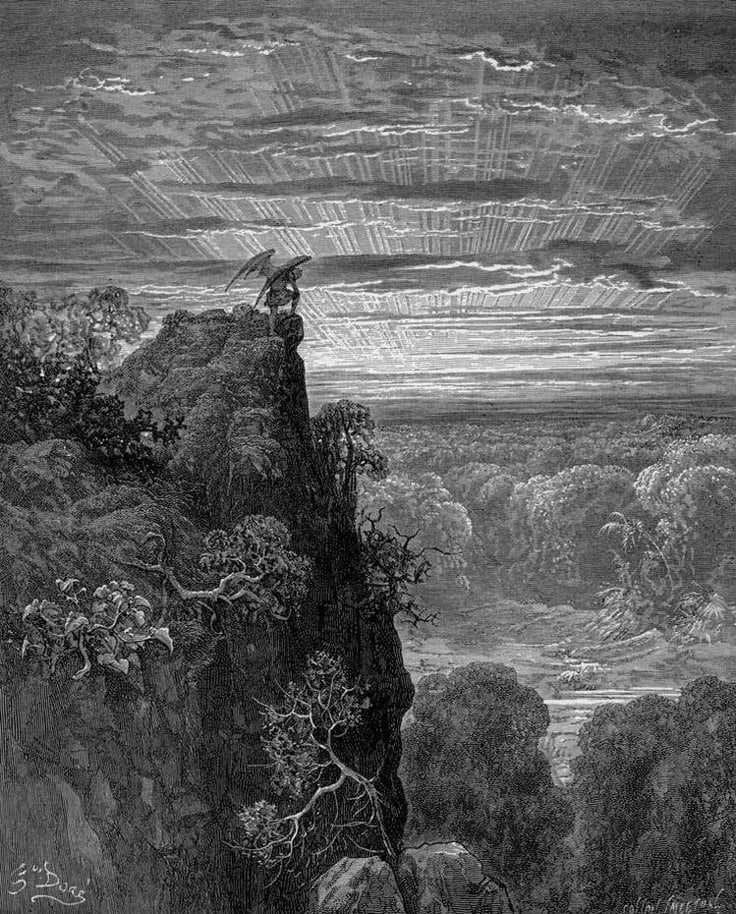
Dante Alighieri, The Divine Comedy (Inferno, Purgatorio and Paradiso). Soon another great historical classic will draw me to my summer reading — this time the somewhat older word of Dante Alighieri, The Divine Comedy, which I have not yet taken up in full, even though I encountered its most recognisable third already in secondary school. I think it was one of by far the most interesting treatments of literary works for me, one that speaks to me already through its mysticism and its archaic status.
Werner Herzog, The Future of Truth. At present I am reading Herzog’s recently published book, The Future of Truth, which comes to me as a particular kind of contemplation of truth that — much like Descartes’ Meditations — proceeds in a numbered, episodic sequence. For me Herzog, insofar as I have read him and, far more, listened to him, is an extraordinary storyteller who, in his calm manner yet deep recognition of nuance, draws on the stories of his own life. In the book he settles into personal or collective thought, memories and stories, touching on the most varied aspects and conceptions of truth (from the historical reality of the race to conquer the South Pole to the elusive, absurd reality of the stories of opera librettos). He is a man who, for me, unites a grounded presence in the present with contemporary ideas about travelling to Mars and the colonisation of humanity in space.
As someone returning more strongly to reading for pleasure, beyond study literature, I choose books much as I choose other beloved works of art: whatever speaks to me intoxicatingly, intensely and stubbornly, and into which I do not find it hard to delve longer and deeper. I am a fairly analytical reader, by which I mean that in reading I seek an affective interpretation, reached through repeated reading of dense passages and through visualisation and a genuine feeling of what has been read.
On the whole I think I am being honest in noting that reading improves my concentration and helps me sharpen abstract thoughts and ideas. When it is reading of my own choosing in my free time, it also relaxes and calms me. I would say that reading is also useful in developing one’s own craft of writing, which is of considerable importance to me.
Beyond its benefit to that craft, reading might also be thought of as a way of improving the recognition and filtering of information, whose influx so strongly marks the spirit of our age. It is interesting that reading also gives insight into the currency and writing of other people; and on the whole, I would infer, it holistically builds empathy, affectivity and rationality.